
You’re a Developer Who Just Got a Vague Feature Request. Now What?
By A. Perico
10 min read
No product manager? No problem. A practical 10-minute framework to turn vague requests like “make it faster” or “add export” into testable engineering work.
Turn Systems Engineering context into delivery alignment.
Ellygent helps teams define system intent, structure engineering context, maintain traceability, and make approved context usable across implementation and AI-assisted workflows.
You’re a Developer Who Just Got a Vague Feature Request. Now What?
You are working normally.
Then this message appears in Slack:
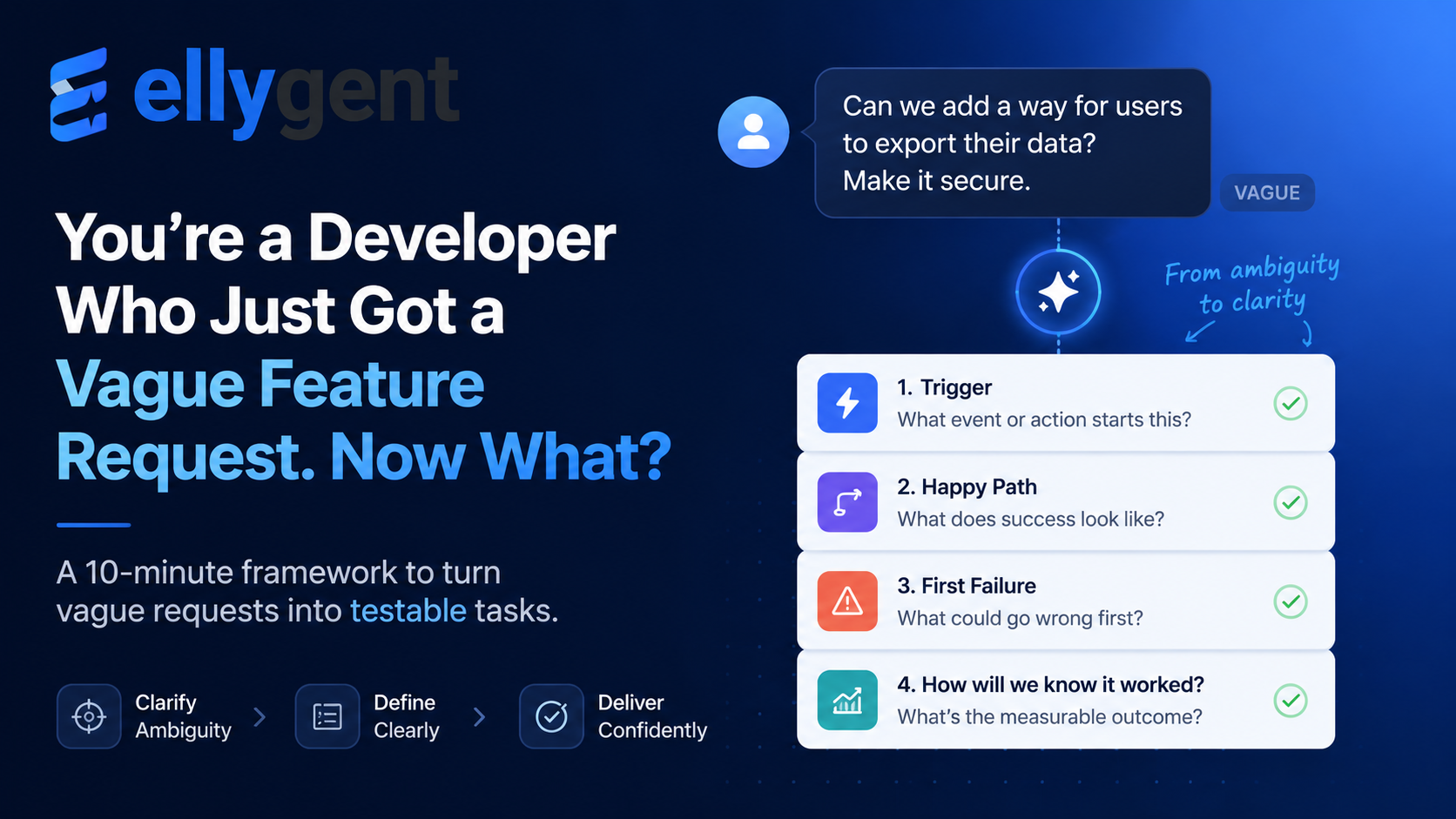
“Hey, can we add a way for users to export their data? Make it secure. Thanks!”
At first, it looks simple.
Export data. Make it secure. Ship it.
But if you are the developer receiving this request, your brain immediately starts asking questions:
- Export which data?
- Export in which format?
- Who can export it?
- Where does the user trigger the export?
- Is this immediate or asynchronous?
- What does “secure” mean here?
- Is the file stored?
- Does the link expire?
- Can another user access the export?
- Do we need audit logs?
- What happens if there is no data?
- What happens if the export fails?
This is the moment where many software teams lose time.
Not because developers are slow.
Not because product people are careless.
But because the feature request skipped the definition step.
The request is not ready to build. It is only ready to clarify.
And now you have two bad options.
Option one: you guess and build something. That feels fast, until the rework starts.
Option two: you ask twenty follow-up questions. That is responsible, but it can make you look difficult, especially in a small team where everyone just wants to move.
 ...
...
There is a better option.
Use a small structure.
Not a heavy process. Not a full requirements document. Not a week of analysis.
Just enough structure to turn a vague request into a testable engineering task.
The real problem with vague feature requests
A vague feature request is not bad because it is short.
Short can be good.
The problem is when short means incomplete.
When someone says:
“Add export.”
They may already have a scenario in their head.
Maybe they imagine a CSV export from a dashboard.
You may imagine a JSON export from an API.
Support may imagine a GDPR data export.
Security may imagine signed URLs and audit logs.
The customer may imagine a one-click Excel file.
Everyone is using the same words, but not the same system.
That is the expensive part.
A vague request creates hidden assumptions. Those assumptions become implementation choices. Those implementation choices become bugs, rework, or uncomfortable conversations later.
The developer should not be expected to guess the system.
But the developer also cannot wait forever for perfect specifications.
So the question is:
What is the minimum structure that makes this request safe enough to implement?
The 4-question framework
Before writing a single line of code, ask four questions.
Write down the answers.
That is important. Do not leave the answers only in Slack, in a meeting, or in someone’s memory.
The goal is to create a small shared definition.
1. What is the trigger?
Ask:
What starts this behavior?
This sounds basic, but it immediately forces clarity.
For example:
“User clicks Export on the workspace dashboard.”
Now you know this is not an automatic background export. It is not an API-only feature. It is not an admin-only console action. It starts from a specific user action.
Better.
You have moved from vague feature to observable trigger.
2. What is the happy path?
Ask:
Walk me through one scenario where everything works.
Do not start with every edge case. Start with one clean flow.
For example:
“User selects CSV format, clicks Export, and receives an email with a download link.”
Now you know the basic behavior.
There is a format. There is a button. There is email delivery. There is a download link. There is probably asynchronous processing.
This already changes implementation.
The vague request was:
“Add export.”
The actual behavior is closer to:
“Generate a CSV export asynchronously and email a download link to the user.”
That is a different requirement.
3. What is the first thing that could go wrong?
Ask:
What is the most likely failure or exception?
Do not try to define every failure mode in the first conversation. Just find the first obvious one.
For example:
“User has no data to export.”
Good.
Now ask:
Should we show an error, or should we show a ‘nothing to export’ message?
That one small question can prevent a future bug.
Because without it, one developer may return an empty CSV. Another may show an error. Another may disable the button. Another may send an email with an empty file.
All of those may be technically valid.
But only one matches the intended product behavior.
4. How will we know it worked?
Ask:
What proves this feature is correct?
This is where vague requests become testable.
For example:
“The user receives the export email within 30 seconds, and the download link works once.”
Now we have verification intent.
We are no longer discussing a vague idea. We are discussing observable behavior.
A tester can test it. A developer can implement it. A product person can accept it. An AI assistant can help improve it. A future engineer can understand why it exists.
That is the difference.
From vague request to structured requirement
Now take the answers and write a requirement.
Original request:
“Can we add a way for users to export their data? Make it secure.”
Structured requirement:
REQ-EXP-001 When a workspace user with export permission clicks Export on the workspace dashboard, the system shall generate a CSV file containing all workspace-owned records available to that user and send a download link to the user’s verified email address within 30 seconds. The download link shall expire after 24 hours or after one successful download, whichever occurs first.
That is much better.
It defines:
- actor
- permission
- trigger
- location
- format
- data scope
- delivery method
- timing expectation
- expiration rule
- verification direction
This is not bureaucracy.
This is a developer protecting future implementation time.
What about “make it secure”?
This is where many teams make a mistake.
They try to hide security inside one vague requirement.
“The export shall be secure.”
That is not enough.
Security is not a decoration. It must be specified as behavior, constraints, and verification.
So split it.
Example security requirements:
REQ-EXP-002 The download link shall use a signed, single-use token that does not expose the storage path or internal file identifier.
REQ-EXP-003 The system shall verify that the requesting user still has export permission before allowing the file to be downloaded.
REQ-EXP-004 The system shall record an audit event when an export is requested and when the file is downloaded.
REQ-EXP-005 The system shall automatically delete generated export files after 24 hours.
Now “secure” is no longer a vague adjective.
It is system behavior.
And because it is behavior, it can be implemented, reviewed, tested, and traced.
Now turn it into acceptance criteria
A requirement is much stronger when it has acceptance criteria.
For this example:
Given a workspace user with export permission
When the user clicks Export on the workspace dashboard
Then the system generates a CSV export containing workspace-owned records available to that user
And the system sends a download link to the user's verified email address within 30 seconds
Given an export download link has already been used
When the user tries to use the same link again
Then the system rejects the request
And the file is not downloadedGiven an export download link was generated more than 24 hours ago
When the user opens the link
Then the system rejects the request
And informs the user that the link has expiredGiven a user no longer has export permission
When the user attempts to download a previously generated export
Then the system denies accessGiven a user requests an export
When the export is created
Then the system records an audit event with the actor, workspace, timestamp, and export statusThis is the point where the feature becomes real.
You now have enough definition for implementation and testing.
Why developers should care
Some developers hear “requirements” and think:
“That is product management work.”
I understand the reaction.
Developers should not be buried in documentation. Developers should not be forced into useless process. Developers should not become translators of unclear business intent all day.
But developers pay the cost when the requirement is vague.
They pay it through:
- rework
- interrupted focus
- repeated clarification
- unstable scope
- unclear acceptance criteria
- failed reviews
- late security questions
- bugs that are actually definition problems
So even if you are not responsible for the whole product definition process, you benefit from having a small framework.
The point is not to become a requirements engineer.
The point is to avoid being forced to guess.
A vague request checklist for developers
When a request feels vague, do not ask twenty random questions.
Ask these:
- Trigger What starts the behavior?
- Actor Who is allowed to do it?
- Happy path What happens when everything works?
- First failure What is the most likely thing that can go wrong?
- Data scope Which data is included, excluded, created, changed, stored, or deleted?
- Constraint What does “fast,” “secure,” “simple,” or “reliable” actually mean here?
- Verification How will we know it worked?
- Traceability Why does this feature exist, and which user or business problem does it solve?
You do not need every answer to start every task.
But if you cannot answer the first four, the task is probably not ready.
How to ask without sounding difficult
This matters.
Developers often avoid asking clarification questions because they do not want to sound negative.
So do not frame it as resistance.
Frame it as alignment.
Instead of:
“This is unclear.”
Try:
“I can build this, but I want to avoid guessing the behavior. Can we define the trigger, happy path, first failure, and acceptance criteria?”
Instead of:
“What does secure mean?”
Try:
“For the security part, should we treat this as signed single-use links, permission check at download time, audit logging, or all three?”
Instead of:
“This ticket is not ready.”
Try:
“I think this needs 10 minutes of definition before implementation so we avoid rework.”
This changes the tone.
You are not blocking. You are reducing risk.
The small-team version of systems engineering
This is where I think many small software teams get systems engineering wrong.
They think systems engineering means heavy process, big documents, formal gates, and slow delivery.
It can become that if done badly.
But the real idea is much simpler:
Define the system before asking people to build the system.
For a small software team, this can be lightweight:
Problem → User scenario → Capability → Requirement → Acceptance criteria → TestThat is enough to create structure without bureaucracy.
Example:
Problem:
Admins need a safe way to export workspace data.

Scenario:
Admin exports data from the workspace dashboard.

Capability:
Export workspace data.

Requirement:
The system shall generate a CSV export and email a single-use download link.

Acceptance criteria:
The link expires after 24 hours or one download.

Test:
Verify export generation, permission check, link expiration, and audit event.
This is systems thinking in a form a small team can actually use.
Where AI helps — and where it does not
AI can help a lot here.
But not if the input is only:
“Write requirements for data export.”
That will usually produce generic output.
Sometimes useful, sometimes not. Often “almost right.”
AI becomes more useful when it receives the same context a good engineer would need:
- problem
- actor
- trigger
- happy path
- failure path
- data scope
- constraints
- security expectations
- acceptance criteria
- verification intent
Then AI can help you:
- rewrite vague requests
- propose missing edge cases
- split security into separate requirements
- generate acceptance criteria
- identify missing permissions
- suggest test cases
- improve clarity and verifiability
The point is not that AI replaces the developer or product manager.
The point is that AI performs better when the system context is structured.
That is exactly the principle behind Ellygent:
Define the system. Give AI real context.
How Ellygent fits this workflow
Ellygent is built around this idea.
Instead of treating requirements as isolated text, Ellygent helps you structure the context around them:
- problem statement
- users and stakeholders
- scenarios and workflows
- capabilities
- requirements
- acceptance criteria
- risks
- verification methods
- traceability
For a solo developer or small team, this means you can take a vague request and turn it into something buildable.
For example:
“Can we add a way for users to export their data? Make it secure.”
Becomes:
- actor
- trigger
- happy path
- exception path
- derived requirements
- security requirements
- acceptance criteria
- test ideas
This is the kind of AI-assisted workflow that actually helps.
Not because AI writes nicer sentences.
But because the system context becomes clear enough for AI to support engineering reasoning.
A 10-minute routine you can use tomorrow
Next time you receive a vague request, do this:
- Paste the request into a note.
- Write the trigger.
- Write the actor.
- Write the happy path.
- Write the first failure case.
- Define what “fast,” “secure,” or “simple” means if those words appear.
- Write one requirement.
- Write three acceptance criteria.
- Confirm with the requester.
That is it.
Ten minutes.
You may still discover more later. That is normal.
But you will have moved from guessing to shared understanding.
And that is already a big improvement.
Final thought
A vague feature request is not a small task.
It is an undefined task.
And undefined tasks are expensive.
They create rework, frustration, bugs, and low-confidence AI output.
The solution is not to turn every developer into a process owner.
The solution is to give developers a simple way to protect themselves and their team from ambiguity.
Start with four questions:
- What is the trigger?
- What is the happy path?
- What is the first thing that can go wrong?
- How will we know it worked?
Then turn the answers into a requirement and acceptance criteria.
That is not bureaucracy.
That is professional software engineering.
Define the system. Give AI real context.
Related Ellygent workflows
Connect this topic to product workflows for system definition, traceability, export, and AI-assisted engineering.
About the author
A. Perico writes about Systems Engineering definition, traceability, AI-assisted engineering workflows, and ways to keep implementation aligned with approved system context.
Define system context with Ellygent.
See how Ellygent supports Systems Engineering workflows from definition through traceability, baselines, and context export.