
Requirements Rationale Is Not Enough: Connect It to Traceability
By A. Perico
10 min read
A requirement rationale explains why a requirement exists, but its value increases when connected to objectives, workflows, risks, architecture, tests, and evidence. Traceability turns rationale into engineering memory.
Turn Systems Engineering context into delivery alignment.
Ellygent helps teams define system intent, structure engineering context, maintain traceability, and make approved context usable across implementation and AI-assisted workflows.
Requirements Rationale Is Not Enough: Connect It to Traceability
A clear rationale explains why a requirement exists. That is already valuable. But in real engineering work, rationale alone is not enough. The reason behind a requirement only becomes truly useful when it is connected to the rest of the system definition.
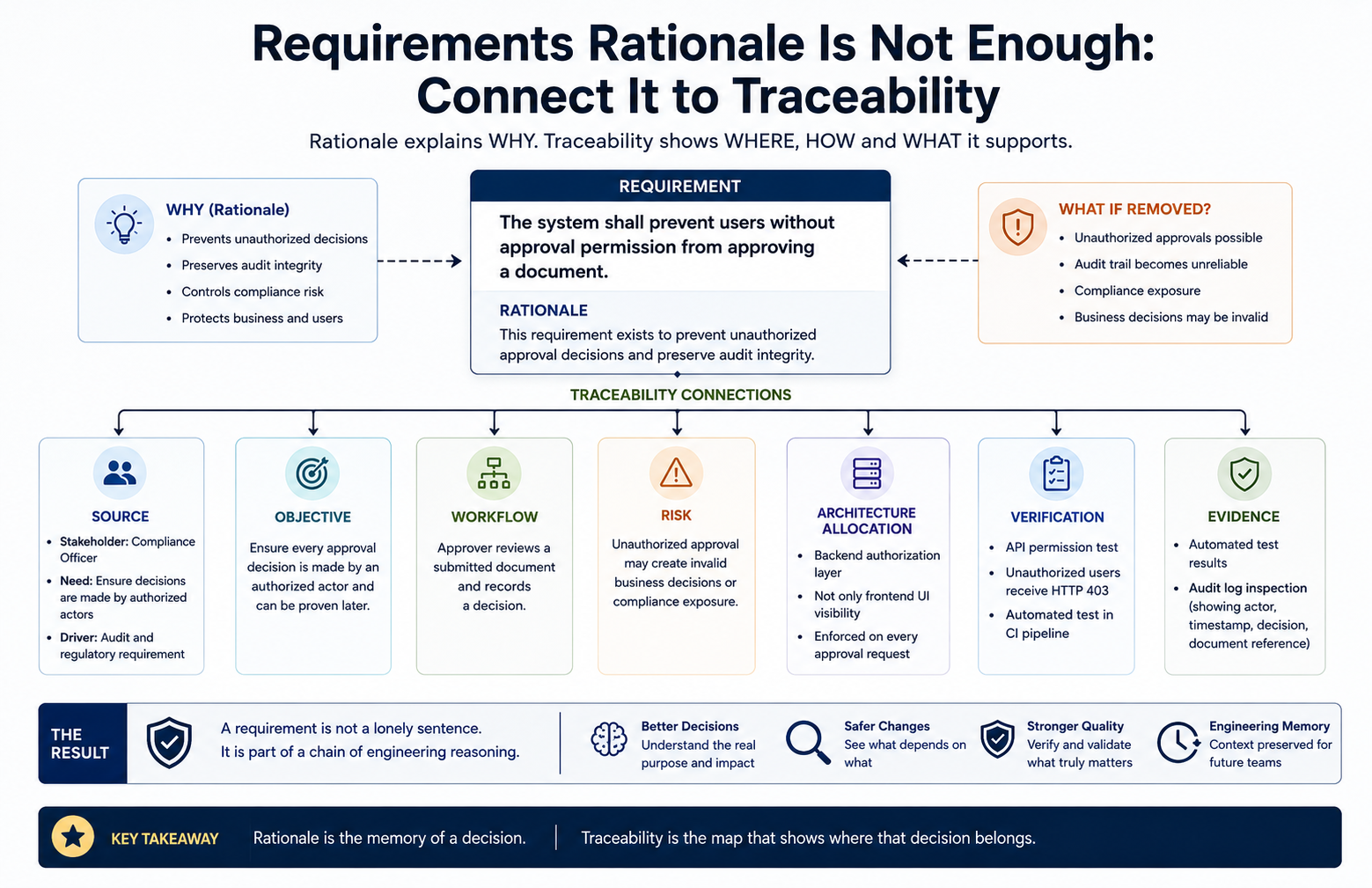 Requirements rationale explains why a requirement exists. Traceability shows where that requirement belongs in the broader engineering chain.
A requirement should not only tell us what the system must do. Its rationale should explain why that behavior matters. Its traceability should show where that behavior came from, what it supports, where it is implemented, and how it will be verified.
Without that connection, rationale becomes another isolated comment. Helpful, but still limited.
The requirement statement tells us the expected behavior. The rationale tells us the reason. Traceability tells us how that requirement belongs to the system.
Rationale explains the reason. Traceability preserves the relationship.
Consider this requirement:
The system shall prevent users without approval permission from approving a document.
That statement is useful. It is clear enough to understand and test. But it is still incomplete as an engineering asset. A future reader may still ask:
- Why does this requirement exist?
- Which user workflow depends on it?
- Which risk does it control?
- Which stakeholder cares about it?
- Which architecture component enforces it?
- Which tests prove it works?
- What breaks if we remove it?
A rationale may answer the first question:
This requirement exists to prevent unauthorized approval decisions and preserve audit integrity.
That is better. But traceability makes it stronger:
- Problem: Approval decisions are currently difficult to control and audit.
- Objective: Ensure every approval decision is made by an authorized actor and can be proven later.
- Workflow: Approver reviews a submitted document and records a decision.
- Risk: Unauthorized approval may create invalid business decisions or compliance exposure.
- Requirement: The system shall prevent users without approval permission from approving a document.
- Architecture allocation: Backend authorization layer, not only frontend UI visibility.
- Verification: API permission test proving unauthorized users receive HTTP 403.
- Evidence: Automated test result and audit log inspection.
Now the requirement is no longer a sentence with an explanation. It is part of a chain of engineering reasoning.
A requirement should not be a lonely sentence
Many teams write requirements as detached statements. The requirement may be grammatically correct and even testable, but still weak because it is disconnected from its source and purpose.
This is where requirements management often becomes fragile. The text exists, but the reasoning does not. The requirement is stored, but the engineering memory around it is lost.
When that happens, future discussions become inefficient. A developer sees complexity. A tester sees another condition to test. A product manager sees scope. A manager sees cost. But without the full chain of reasoning, each person evaluates the requirement from a local perspective.
That is exactly how important requirements get simplified for the wrong reason.
Traceability protects against that. It does not make every requirement untouchable. It simply makes the consequences of changing it visible.
Traceability makes change discussions more intelligent
Requirements change. That is normal. The problem is not change. The problem is changing something without understanding what else depends on it.
Without rationale, the discussion sounds like this:
“Can we remove this requirement? It seems unnecessary.”
With rationale, the discussion improves:
“This requirement exists because unauthorized approvals create audit risk.”
With rationale and traceability, the discussion becomes much more precise:
“This requirement supports the auditability objective, protects the approval workflow, is allocated to the backend authorization layer, and is verified by three permission tests. If we remove it, we also need to revisit the audit requirement, the security test suite, and the compliance evidence.”
That is a different level of conversation.
Traceability does not prevent decisions. It improves the quality of decisions. It allows teams to change requirements consciously instead of accidentally breaking the logic behind them.
Traceability is not only for regulated industries
Traceability is often treated as something required only in automotive, aerospace, medical, defense, or safety-critical environments. Those domains certainly need stronger traceability because they need stronger evidence. But the basic need is not exclusive to regulated industries.
A SaaS team also needs to answer:
- Why does this feature exist?
- Which user problem does it solve?
- Which product objective does it support?
- Which workflow depends on it?
- Which acceptance criteria prove it works?
- Which tests cover it?
- Which metric tells us whether it delivered value?
That does not require a heavy process. It requires a useful chain of reasoning.
For many software teams, a lightweight traceability model is enough:
Problem → User journey → Capability → Requirement → Acceptance criteria → Test → Validation signal
This is not bureaucracy. This is the minimum structure needed to understand what the team is building and why.
Backlog items are not the same as system understanding
A large backlog can give the illusion of clarity. It may contain hundreds of tickets, many labels, detailed estimates, and several sprint plans. But ticket volume does not mean the system is understood.
Consider a common backlog item:
As an admin, I want to manage users.
This may be a valid starting point, but it is not yet enough for implementation. The team still needs to understand:
- Which admin roles exist?
- Can admins invite users?
- Can they remove users?
- Can they change roles?
- Can they remove themselves?
- Can they deactivate another admin?
- What happens to active sessions after access is revoked?
- Are changes logged?
- Do invitations expire?
- Can the same email receive multiple invitations?
- What happens if the email provider fails?
- Which tests prove the permission model works?
These are not documentation details. These are engineering decisions.
A backlog item captures intent at a small level. Systems engineering connects that intent to the wider context: problem, actors, workflows, capabilities, risks, requirements, architecture, tests, and validation evidence.
Without this connection, teams often end up using implementation as the discovery method. That is expensive. It means developers discover product behavior while coding, testers discover missing rules during QA, and users discover edge cases in production.
Rationale should connect to verification
A strong rationale often reveals what kind of verification is needed.
For example:
This requirement exists to ensure that approval decisions are made only by authorized users and can be defended during an audit.
This rationale tells us that testing only the happy path is not enough.
The team should verify:
- That an authorized approver can approve.
- That an unauthorized user cannot approve.
- That the backend rejects unauthorized approval attempts.
- That frontend visibility is not the only control.
- That approval decisions are recorded in the audit log.
- That the audit record contains actor, timestamp, decision, and document reference.
Without rationale, the team may verify only the easiest interpretation of the requirement. With rationale, the team is more likely to verify the real risk being controlled.
This is one of the strongest reasons to write rationale early. It improves verification planning. It helps the team choose better tests, not only more tests.
Rationale should connect to architecture
Requirements are eventually satisfied by architecture. If the requirement is important, the allocation is important too.
Take the same requirement again:
The system shall prevent users without approval permission from approving a document.
If the rationale is only “users should not see actions they cannot perform,” the team may implement this as a frontend visibility rule. Hide the button and move on.
But if the rationale is “prevent unauthorized decisions and preserve audit integrity,” then the architecture decision changes. The real enforcement must happen in the backend. The frontend can improve usability, but it cannot be the security boundary.
A traceable requirement record can make this explicit:
- Frontend: Hide approval actions from users without permission.
- Backend API: Enforce authorization for every approval decision.
- Database: Store decision, actor, timestamp, and document state.
- Audit mechanism: Preserve decision history for later inspection.
- Test suite: Verify both successful and rejected approval attempts.
This is where rationale and traceability prevent shallow implementation. They help the team understand not only what to build, but where the responsibility belongs.
Rationale should connect to validation
Verification and validation are not the same thing.
Verification asks:
Did we build the requirement correctly?
Validation asks:
Did the requirement help solve the real problem?
A requirement may be fully verified and still fail to deliver the intended result.
Example:
The system shall notify the assigned approver within 30 seconds after a document is submitted for approval.
The rationale may be:
This requirement exists to reduce approval delays caused by approvers not knowing that action is required.
Verification can prove that the notification is technically sent within 30 seconds. But validation asks whether approval delays actually decreased.
If the notifications are sent but approvers ignore them, the requirement is verified but the problem may remain. The team may need escalation rules, reminders, dashboard visibility, digest emails, or workload balancing.
This is why rationale should connect to product objectives and validation metrics. The reason behind the requirement often points to the metric that should be watched after release.
Good rationale has a source
Poor rationale is almost as bad as no rationale. Statements like “best practice,” “customer asked,” or “industry standard” are weak unless they explain the real reason behind the decision.
A better rationale connects the requirement to at least one concrete source:
- A stakeholder need.
- A product objective.
- A user journey.
- An operational constraint.
- A safety, security, privacy, or compliance risk.
- A known defect or incident.
- An architecture decision.
- A verification or audit need.
Compare these examples:
Weak rationale: This is best practice.
Better rationale: This requirement exists because inactive invitations have previously caused user confusion and duplicate support requests.
Weak rationale: Customer requested it.
Better rationale: Enterprise workspace admins need exported audit logs to support quarterly access reviews.
Weak rationale: Security requirement.
Better rationale: Server-side authorization is required because frontend visibility controls can be bypassed through direct API calls.
The stronger rationales explain what problem would reappear if the requirement disappeared.
A lightweight SaaS example
Consider a SaaS product that allows workspace admins to invite users.
A requirement could be written as:
The system shall prevent duplicate active invitations for the same email address within the same workspace.
That is clear and testable. But the requirement becomes more useful when connected to rationale and traceability:
- Problem: Workspace owners rely on support to add users manually, creating delays and inconsistent handling.
- Objective: Reduce user-management support tickets by 80%.
- Workflow: Admin invites a new user by email.
- Capability: Manage workspace membership.
- Requirement: The system shall prevent duplicate active invitations for the same email address within the same workspace.
- Rationale: Duplicate invitations confuse users, create inconsistent invitation states, and increase support requests.
- Architecture allocation: Backend invitation service and database uniqueness rule.
- Verification: API test proving the second active invitation is rejected.
- Validation: Monitor reduction in support tickets related to duplicate or confusing invitations.
This is not a heavy specification. It is a compact engineering record.
The team now understands the requirement from several angles: user problem, product objective, workflow, capability, technical enforcement, test strategy, and validation signal.
AI makes this even more important
AI tools can generate requirement text quickly. That is useful, but also dangerous if the generated requirement is disconnected from the real system context.
A generated requirement can look professional and still be wrong. It can be clear, grammatical, and structured while missing the actual stakeholder need, workflow, risk, constraint, or verification intent.
This is why rationale and traceability matter even more in AI-assisted requirements work.
AI should not only help write requirement statements. It should help answer engineering questions:
- What objective does this requirement support?
- Which workflow step created this requirement?
- Which edge case is this requirement controlling?
- Which risk does it reduce?
- Which architecture component should satisfy it?
- Which acceptance criteria should verify it?
- Which requirements have no rationale?
- Which requirements have no downstream test?
- Which tests have no requirement behind them?
AI without structured context produces plausible text. AI with structured context can support engineering reasoning.
That difference matters.
What good rationale-traceability looks like
A practical requirement record should answer seven questions:
- What is required? The requirement statement.
- Why is it required? The rationale.
- Where did it come from? Stakeholder need, objective, scenario, risk, constraint, or decision.
- What does it support? Capability, workflow, product goal, safety argument, or compliance need.
- Where is it implemented? Architecture element, service, component, interface, or manual process.
- How is it verified? Inspection, analysis, demonstration, test, simulation, or review.
- How is it validated? Operational result, business metric, user behavior, safety evidence, or compliance evidence.
If a requirement cannot answer these questions, the team may still be able to implement it. But it will be harder to manage, review, change, test, and defend later.
Final thought
Requirements rationale is not just an explanation field. Traceability is not just an audit matrix.
Together, they preserve engineering reasoning.
A requirement with no rationale is easy to misunderstand. A requirement with rationale but no traceability is easier to understand, but still difficult to manage. A requirement connected to its source, objective, workflow, risk, architecture, verification method, and evidence becomes a durable engineering asset.
If rationale is the memory of a decision, traceability is the map that shows where that decision belongs.
References
Related Ellygent workflows
Connect this topic to product workflows for system definition, traceability, export, and AI-assisted engineering.
About the author
A. Perico writes about Systems Engineering definition, traceability, AI-assisted engineering workflows, and ways to keep implementation aligned with approved system context.
Define system context with Ellygent.
See how Ellygent supports Systems Engineering workflows from definition through traceability, baselines, and context export.